When I first started using online software, I did not really think much about how the payment system worked. I simply created an account, selected a plan, entered my payment details, and started using the software. Later, I realized that most of these online tools work through something called a SaaS subscription.
SaaS stands for Software as a Service. Instead of buying software once and installing it permanently on a computer, I pay for access to the software for a certain period. Usually, this period isisi article pr ik wordpress k liya image bna k do jo adsense frindly hu one month or one year. As long as the subscription remains active, I can continue using the software and its features.
In my opinion, SaaS subscriptions have completely changed the way people use software. They have made powerful tools available to individuals, freelancers, students, bloggers, businesses, and large companies without requiring them to make a huge payment at the beginning.
What Is a SaaS Subscription?
A SaaS subscription is basically a payment arrangement between a customer and a software company. The customer pays regularly to access a software product that is hosted online.
For example, imagine that I want to use a project management tool. Instead of purchasing a software package and installing it on my computer, I can visit the company’s website, create an account, choose a subscription plan, and start using the tool through my browser.
The company manages the software, servers, security, updates, and technical infrastructure. I simply use the service.
This is one of the biggest differences between traditional software and SaaS software. With traditional software, I might have to purchase a license and install the application myself. With SaaS, most of the technical work happens behind the scenes.
How the Subscription Process Works
The process is usually very simple. First, I visit the SaaS company’s website and look at the available plans. Most companies offer several options depending on the user’s needs.
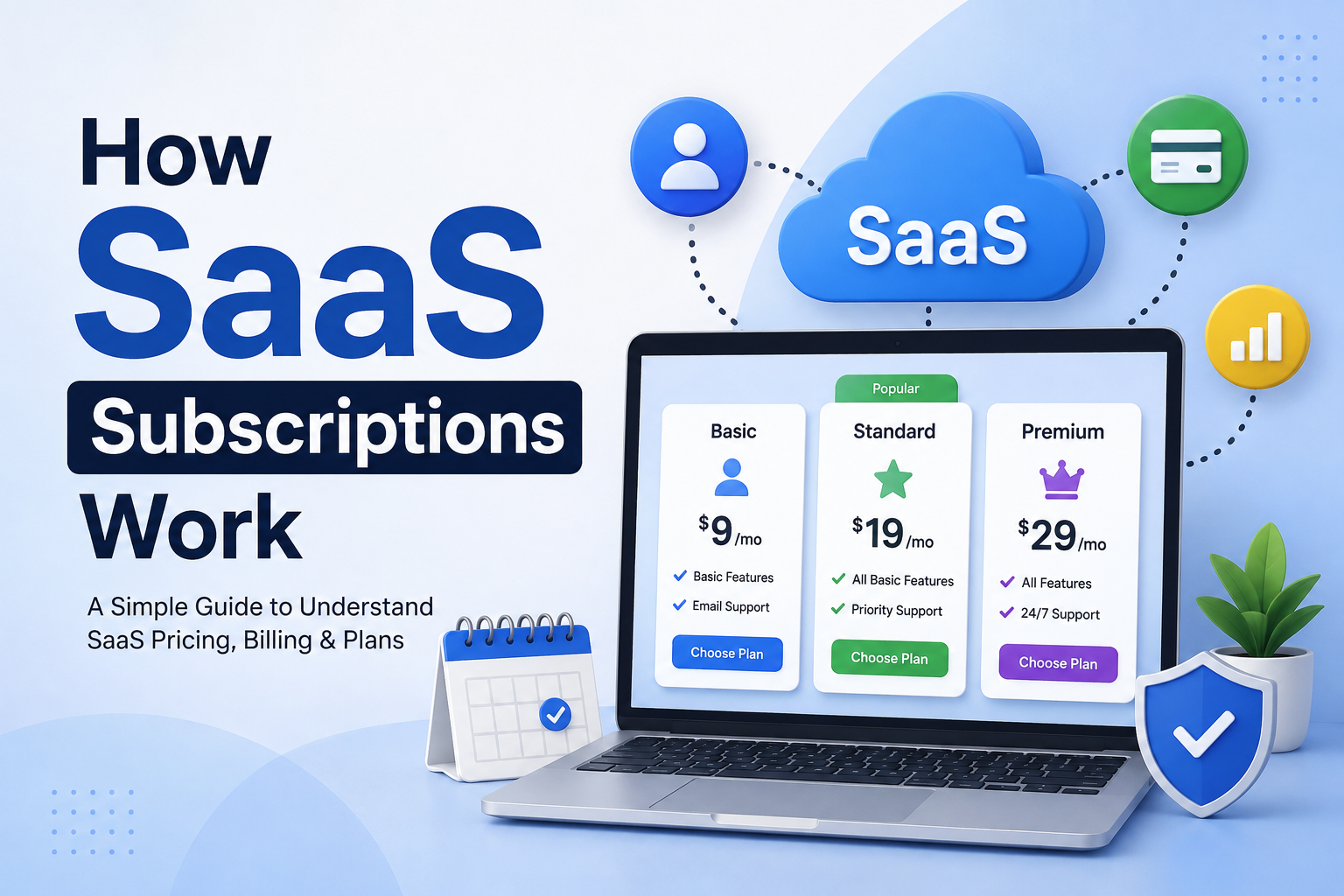
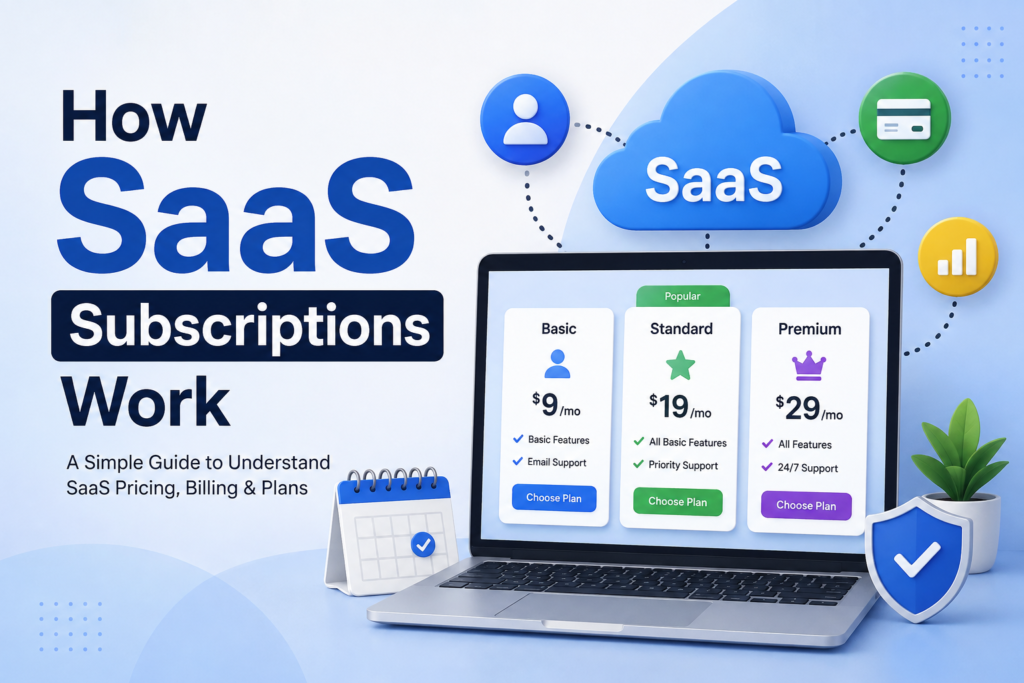
There may be a free plan, a basic plan, a professional plan, and an advanced business plan. Each plan usually comes with different features, storage limits, users, or usage limits.
After choosing a plan, I create an account. Some services allow me to start with a free trial before asking for payment. Others require payment immediately.
Once the payment is completed, my account gets access to the features included in my selected plan.
For example, a basic subscription might allow me to use the software for one person with limited storage. A professional subscription might provide more storage, advanced features, and additional users.
The software company keeps track of my subscription status automatically. If my subscription is active, I can use the service. If I cancel it and the subscription period ends, access to paid features may be restricted.
Monthly and Annual Subscriptions
One thing I always look at when choosing SaaS software is whether the company offers monthly or annual billing.
Monthly subscriptions are useful when I am not sure how long I will need a particular service. I can pay every month and cancel when I no longer need it.
Annual subscriptions usually require a larger payment upfront, but they often cost less when calculated over twelve months. For example, a service might charge $15 per month when billed monthly but offer an annual plan that brings the monthly cost down.
Personally, I think monthly plans are better for testing a service, while annual plans can make more sense when I already know that I will use the software regularly.
Free Trials
Free trials are another important part of SaaS subscriptions. Many software companies allow new users to try their premium features for a limited period.
A trial might last seven days, fourteen days, or thirty days. During this period, I can explore the software and decide whether it actually provides value.
I find free trials useful because screenshots and advertisements cannot always tell me whether a tool is right for my needs. Using the actual software gives me a much better idea of its quality.
However, I always check the trial terms carefully. Some services automatically charge the payment method after the trial ends. Knowing the renewal date can help avoid unexpected charges.
Automatic Renewals
Most SaaS subscriptions use automatic renewal. This means that when the current billing period ends, the company charges the payment method again.
For example, if I subscribe to a monthly service on August 10, the subscription may renew around the same date in September.
Automatic renewal is convenient because I do not have to manually pay every month. I can continue using the software without interruption.
At the same time, automatic renewal can become a problem if I forget about a subscription. This is why I believe it is important to regularly review the subscriptions I am paying for.
Sometimes people subscribe to a tool for one particular project and then forget about it. Months later, they may still be paying for something they barely use.
What Happens When I Cancel?
Cancellation policies can be different from one SaaS company to another.
In many cases, when I cancel a subscription, I can continue using the paid features until the end of the current billing period. After that, the account may move to a free plan or lose access to premium features.
For example, if I pay for a full month and cancel after ten days, I may still have access for the remaining twenty days.
Some companies may offer refunds, while others may not. Because of this, I think it is always worth checking the cancellation and refund policy before subscribing.
Upgrading and Downgrading
Another useful feature of SaaS subscriptions is flexibility.
If I start with a basic plan and later realize that I need more features, I can usually upgrade my subscription. The new plan may provide additional storage, users, integrations, or advanced tools.
On the other hand, if I am paying for features that I do not use, I may be able to downgrade to a cheaper plan.
This flexibility is one of the reasons I prefer SaaS products for many online tasks. I do not have to commit to expensive software permanently. I can change my plan according to my current requirements.
How SaaS Companies Make Money
The subscription model gives SaaS companies a predictable source of revenue.
Instead of relying only on one time software purchases, companies can earn recurring income from customers who continue using their services.
This recurring revenue also allows software companies to keep improving their products. They can invest in new features, customer support, security, infrastructure, and development.
From my point of view, this model can benefit both sides when the software company continues to provide real value. I am happy to keep paying for a tool when I can clearly see that it saves me time or helps me achieve better results.
Different Types of SaaS Pricing
Not every SaaS company charges customers in exactly the same way.
Some services charge a fixed monthly amount. Others charge according to the number of users. Some charge based on storage, usage, projects, or specific features.
For example, a team collaboration platform might charge according to the number of employees using the service. A cloud storage platform may charge according to the amount of storage I need.
There are also SaaS products that combine different pricing methods. A company might have a basic subscription price and then charge extra for additional users or advanced features.
Because of this, I do not think the cheapest advertised price always represents the actual cost. I prefer looking at what is included in the plan and calculating what I will realistically pay based on my usage.
The Importance of Managing SaaS Subscriptions
As the number of online tools grows, subscription management becomes increasingly important.
It is very easy to collect several subscriptions without realizing how much they cost together. One tool might cost $10 per month, another $15, and another $20. Individually, these amounts may not seem large, but together they can become a significant monthly expense.
I personally believe that reviewing subscriptions every few months is a good habit. I can check which tools I still use, which ones I rarely open, and which services are no longer providing enough value.
Canceling unused subscriptions can save money without affecting my daily work.
SaaS Subscriptions and Businesses
SaaS subscriptions are not only useful for individuals. Businesses depend heavily on them as well.
A small company might use separate SaaS tools for email marketing, accounting, customer management, communication, file storage, website analytics, and project management.
Instead of purchasing expensive servers and maintaining complicated software systems internally, businesses can subscribe to services that are already managed by specialized companies.
This can reduce technical responsibilities and make it easier for teams to work from different locations.
For remote teams especially, SaaS software can be extremely useful because employees can often access the same tools from different devices and locations.
What I Look for Before Paying
Before subscribing to a SaaS product, I try to look beyond the price.
First, I check whether the software actually solves the problem I have. There is no point paying for dozens of features if I only need two or three.
I also check the pricing structure, cancellation policy, storage limits, user limits, customer support, and available integrations.
Another thing I consider is whether the company provides a free trial or free version. If possible, I prefer testing the software before making a long term commitment.
Security is also important. Since SaaS products often store information online, I want to understand how the company handles account security and user data.
Final Thoughts
In my view, SaaS subscriptions have made software much easier to access. Instead of spending a large amount of money on traditional software, I can subscribe to a service and pay according to my needs.
The biggest advantage is flexibility. I can start with a small plan, test the software, upgrade when necessary, or cancel when I no longer need it.
At the same time, SaaS subscriptions require some responsibility from the user. Automatic renewals, multiple subscriptions, and different pricing structures can make it easy to spend more than expected.
For me, the best approach is simple. I look at the actual value of the software, understand the pricing, check the renewal terms, and regularly review the subscriptions I am paying for.
When a SaaS product genuinely saves my time, improves my work, or helps me achieve something that would otherwise be difficult, I consider the subscription worthwhile. But if I stop using a service, I do not see a reason to keep paying for it.
That is how I look at SaaS subscriptions. They are not simply monthly payments for software. They are a flexible way of accessing digital tools, and when used carefully, they can make both personal and professional work much easier.