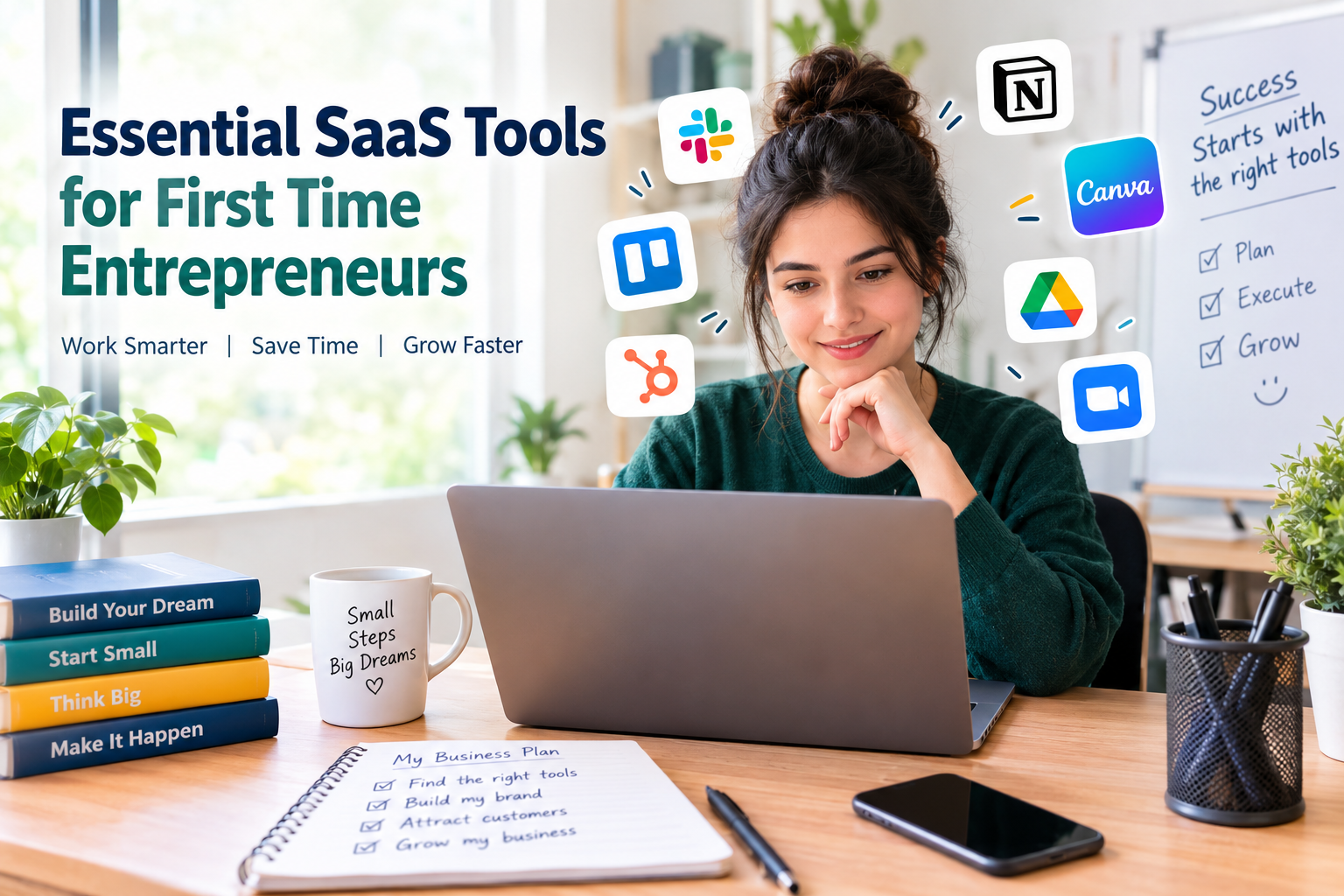
Starting a business for the first time is an exciting experience, but it also comes with many challenges. From managing customers and organizing daily tasks to handling finances and promoting products, entrepreneurs have to manage several responsibilities at once. In the beginning, hiring a large team or investing in expensive business software is not always possible.
This is where SaaS tools for first time entrepreneurs become useful. SaaS stands for Software as a Service, which means users can access software through the internet without installing complicated systems or maintaining expensive infrastructure.
In my opinion, choosing the right SaaS tools early can make business management easier, save valuable time, and help entrepreneurs focus on growth instead of repetitive work.
However, there is no need to purchase every popular tool available. The smarter approach is to start with essential software that solves real business problems and expand your toolkit as your business develops.
In this guide, I will discuss some essential SaaS tools for startups, their features, and how first time entrepreneurs can use them to build an organized and productive business.
Why SaaS Tools Matter for First Time Entrepreneurs
When starting a business, time and money are usually limited. Entrepreneurs often handle marketing, customer support, sales, accounting, and project management themselves.
Using reliable SaaS software can simplify these responsibilities.
Some important benefits include:
- Affordable business management: Many SaaS platforms offer free plans or flexible subscriptions.
- Better productivity: Automation reduces repetitive manual tasks.
- Easy collaboration: Entrepreneurs can work with remote employees and freelancers.
- Improved organization: Important documents, customer information, and projects remain accessible.
- Business scalability: Cloud based software can support changing business requirements.
The biggest advantage, in my experience, is that SaaS tools allow small businesses to operate with better organization without immediately increasing their operational expenses.
1. for Business Planning and Organization
Every new entrepreneur needs a central place to organize ideas, plans, documents, and business goals. Notion provides a flexible workspace where users can create notes, databases, task lists, and project dashboards.
I consider Notion particularly useful for entrepreneurs who have many ideas but need a structured way to manage them.
Key Features
- Business planning templates
- Task and project management
- Document organization
- Team collaboration
- Custom dashboards
For example, you can create a business launch checklist, maintain a content calendar, and store important company documents in one workspace.
Notion offers a free plan, making it accessible to beginners who want to organize their operations without paying immediately.
Website: https://www.notion.com
2. for Project Management
Managing multiple business tasks can quickly become confusing, especially when working alone or with a small team.
Trello uses a visual board system that allows entrepreneurs to organize tasks into lists and cards. It is simple to understand, even for people who have never used project management software.
Key Features
- Visual task boards
- Due dates and reminders
- Task assignments
- Workflow organization
- Team collaboration
A first time entrepreneur can create lists such as Ideas, To Do, In Progress, and Completed.
This makes it easier to understand what needs attention and which tasks have already been finished.
Trello provides a free plan with paid options for additional functionality.
Website: https://trello.com
3. for Marketing and Graphic Design
Marketing is important for every new business, but hiring a professional designer may not fit an early stage budget.
Canva helps entrepreneurs create professional looking graphics without advanced design knowledge.
I find it useful for small business owners who need attractive marketing materials while keeping their expenses under control.
Key Features
- Social media post templates
- Presentation design
- Business cards
- Marketing materials
- Brand kits
- Ready made design elements
You can use Canva to create Instagram posts, promotional banners, presentations, and basic business graphics.
Its free plan is suitable for many beginners, while paid plans provide additional design features.
Website: https://www.canva.com
4. for Customer Management
Customers are the foundation of any successful business. However, keeping track of customer conversations, inquiries, and sales opportunities through spreadsheets can become difficult as the business grows.
HubSpot CRM helps entrepreneurs manage customer relationships in an organized way.
Key Features
- Contact management
- Sales pipeline tracking
- Customer interaction history
- Email tracking features
- Sales reporting
- Marketing integrations
For example, if a potential customer contacts your business, you can save their information and track the progress of the conversation.
This reduces the possibility of forgetting important follow ups.
HubSpot provides free CRM functionality, with additional features available through paid products.
Website: https://www.hubspot.com
5. for Daily Business Operations
For everyday business communication and document management, Google Workspace offers several useful applications.
It includes Gmail, Google Drive, Google Docs, Google Sheets, Google Meet, and other productivity services.
In my view, having these tools connected can make daily operations much easier for new entrepreneurs.
Key Features
- Professional business email
- Cloud document storage
- Online spreadsheets
- Video meetings
- Shared calendars
- Real time document collaboration
You can use Google Sheets to track expenses, Google Docs to prepare business proposals, and Google Drive to store important files.
Google offers different subscription plans, so entrepreneurs should review current pricing before selecting a package.
Website: https://workspace.google.com
6. for Email Marketing
Email marketing remains a useful way to communicate with potential customers and existing clients.
Mailchimp helps entrepreneurs create email campaigns, manage subscribers, and automate selected marketing activities.
For a startup, building an email list can provide a direct communication channel with interested customers.
Key Features
- Email campaign creation
- Subscriber management
- Marketing automation
- Email templates
- Campaign analytics
- Audience segmentation
For example, an online store can send product updates, promotional emails, and welcome messages to subscribers.
Mailchimp offers entry level options, although available features and subscriber limits depend on the selected plan.
Website: https://mailchimp.com
7. for Team Communication
As a business begins to grow, communication becomes more complicated. Important discussions can easily get lost in long email conversations.
Slack provides organized communication channels where teams can discuss projects, share files, and exchange updates.
Key Features
- Organized messaging channels
- Direct messages
- File sharing
- App integrations
- Searchable conversations
- Team collaboration
A startup can create separate channels for marketing, customer support, operations, and general discussions.
This helps keep communication organized and reduces unnecessary interruptions.
Slack has a free option with limitations and paid plans for additional capabilities.
Website: https://slack.com
8. for Accounting and Financial Management
Financial management is one of the most important responsibilities for first time entrepreneurs.
Without proper records, it becomes difficult to understand business expenses, income, and profitability.
QuickBooks provides accounting software designed to help businesses organize their finances.
Key Features
- Income and expense tracking
- Invoice creation
- Financial reports
- Expense categorization
- Cash flow monitoring
- Accounting integrations
For example, freelancers and small business owners can use accounting software to monitor payments and maintain organized financial records.
QuickBooks offers different subscription plans, and availability of features may vary by country.
Entrepreneurs should also confirm that their selected software supports local tax and accounting requirements.
Website: https://quickbooks.intuit.com
9. for Online Meetings
First time entrepreneurs often communicate with clients, freelancers, suppliers, and business partners remotely.
Zoom makes online meetings easier through video conferencing and collaboration features.
Key Features
- Video meetings
- Screen sharing
- Meeting scheduling
- Team communication
- Recording options on eligible plans
- Remote collaboration
You can use Zoom to conduct client consultations, discuss projects, or interview potential employees.
Its free plan supports basic meeting requirements, while paid subscriptions provide additional features.
Website: https://zoom.us
10. for Business Automation
One of the biggest challenges for entrepreneurs is managing repetitive work.
Zapier connects different applications and allows users to automate selected workflows without needing advanced programming skills.
I believe automation becomes especially useful when a business starts receiving regular customer inquiries or handling multiple marketing activities.
Key Features
- Application integrations
- Automated workflows
- Form submission automation
- Customer data transfer
- Notification automation
- Repetitive task reduction
For example, you can create a workflow that sends form responses to a spreadsheet and notifies your team when a new inquiry arrives.
Zapier offers a free plan with usage limits and paid options for more advanced automation.
Website: https://zapier.com
How to Choose the Right SaaS Tools for Your Startup
Choosing business software should not be based only on popularity. Every entrepreneur has different goals, budgets, and operational requirements.
Before purchasing any subscription, consider the following factors.
Understand Your Business Needs
Start by identifying the problems you want to solve.
If you struggle with customer tracking, consider CRM software. If your biggest challenge is task organization, project management software may be more useful.
Check Free Plans
Many SaaS companies offer free plans or trials. Use these opportunities to understand whether a tool fits your workflow before committing to a paid subscription.
Consider Ease of Use
Complicated software can consume more time than it saves.
For beginners, simple interfaces and accessible support resources are important.
Review Pricing Carefully
Do not focus only on the starting price. Check user limits, storage restrictions, automation allowances, and additional charges.
Think About Integration
Your business tools should work together where practical.
For example, connecting a CRM with email marketing software can help reduce manual data entry.
Common SaaS Mistakes First Time Entrepreneurs Should Avoid
Although SaaS tools provide many benefits, using too many applications can create unnecessary complexity.
Here are some common mistakes I recommend avoiding.
Buying unnecessary subscriptions: Do not pay for advanced features before you actually need them.
Using multiple tools for the same purpose: Choose a clear primary application for each major business function.
Ignoring data security: Use strong passwords, enable two factor authentication where available, and review access permissions.
Failing to monitor expenses: Small monthly subscriptions can become a significant business expense over time.
Ignoring employee training: Make sure everyone understands how to use the software properly.
A simple technology setup is often easier to maintain than a large collection of disconnected applications.
Final Thoughts
Starting a business does not require a huge technology budget. With the right SaaS tools for first time entrepreneurs, even a small startup can manage customers, organize projects, improve marketing, and monitor finances more efficiently.
From Notion and Trello to HubSpot, Canva, and Google Workspace, each platform serves a different business purpose.
My personal approach would be to begin with a small collection of essential tools, learn how they fit into daily operations, and add new subscriptions only when a genuine need appears.
Remember, software alone cannot build a successful business. Clear goals, consistent effort, customer understanding, and smart financial decisions remain equally important.
The real purpose of SaaS software is to make your work easier so you can spend more time building a business that lasts.
Frequently Asked Questions
What are the best SaaS tools for first time entrepreneurs?
Useful options include Notion for organization, Trello for project management, Canva for design, HubSpot for customer management, and Google Workspace for daily operations. The right selection depends on business requirements and budget.
Are there free SaaS tools for startups?
Yes. Several platforms offer free plans, including Notion, Trello, Canva, HubSpot CRM, Slack, and Zoom. Free plans usually have usage limits or restricted features.
How many SaaS tools should a beginner use?
There is no fixed number. Beginners can start with a few essential applications covering communication, task management, customer relationships, and financial records.
Can SaaS tools help a business grow?
SaaS tools can support business growth by improving organization, reducing repetitive work, supporting collaboration, and providing useful business information. However, results depend on how effectively the tools are used.
Are SaaS tools suitable for solo entrepreneurs?
Yes. Many SaaS platforms are designed for individuals and small teams. They allow solo entrepreneurs to manage business activities without hiring specialists for every task.