Introduction
Running a business involves many small and large responsibilities every day. From answering emails and managing projects to communicating with employees, organizing documents, tracking deadlines, and handling customer requests, business owners have to manage several activities at the same time. Without a proper system, even simple tasks can become stressful and time consuming.
In my opinion, managing daily business tasks becomes much easier when we use the right technology. This is where SaaS tools can make a real difference. SaaS stands for Software as a Service, which means software that users can access through the internet without installing complicated programs on their computers.
Today, many businesses use SaaS tools to improve productivity, organize their work, reduce manual effort, and communicate more effectively. Whether someone runs a small startup, an online store, a marketing agency, or a growing company, the right business management software can help keep daily operations organized.
In this article, I will discuss some of the best SaaS tools for managing daily business tasks, their useful features, and how they can help businesses work smarter.
What Are SaaS Tools for Business Management?
SaaS tools are cloud based applications designed to help individuals and organizations complete different tasks online. Instead of purchasing expensive software and managing complicated installations, users can usually access these applications through a web browser or mobile application.
For daily business management, SaaS tools can support activities such as:
- Project planning and task management
- Team communication and collaboration
- Email and document management
- Customer relationship management
- Accounting and financial tracking
- Marketing and content creation
- Scheduling and time management
The main advantage is that business information can remain accessible to authorized team members from different locations. This is particularly helpful for remote teams and businesses that operate online.
Best SaaS Tools for Managing Daily Business Tasks
1. <Entity value=”Asana” category=”software” disambig=”Project and task management platform”
Asana is a popular project management platform that helps businesses organize tasks, projects, and team responsibilities. I find this type of software especially useful when several people are working on the same project.
With Asana, users can create tasks, assign responsibilities, set deadlines, and monitor progress. Managers can also organize projects into different sections to understand which activities are completed and which still need attention.
For example, a digital marketing agency can use Asana to manage content writing, graphic design, social media publishing, and client approvals in one place.
Key features include:
- Task assignment and tracking
- Project timelines
- Team collaboration
- Workflow management
- Deadline reminders
Asana can help businesses reduce confusion and maintain a clear view of their daily responsibilities.
2. <Entity value=”Trello” category=”software” disambig=”Visual project management application”
Trello is another useful SaaS tool for managing daily business tasks. It uses a visual board system where users can create cards and move them between different stages of work.
For example, a business can create columns named To Do, In Progress, Under Review, and Completed. Each task can have its own deadline, description, checklist, and attachments.
In my view, Trello is particularly helpful for freelancers, small business owners, and teams that prefer a simple way to organize work.
Key features include:
- Visual task boards
- Drag and drop organization
- Task checklists
- Due dates
- Team collaboration
Its straightforward design makes it easier to understand project progress without spending too much time learning complicated features.
3. <Entity value=”Google Workspace” category=”software” disambig=”Cloud productivity and collaboration suite”
Google Workspace is one of the most practical SaaS solutions for everyday business operations. It combines several productivity applications, including Gmail, Google Drive, Google Docs, Google Sheets, Google Meet, and Google Calendar.
I believe having these tools connected can save considerable time because employees do not need to switch between unrelated platforms for every activity.
Businesses can use Gmail for professional communication, Google Docs for writing reports, Sheets for tracking information, and Drive for storing documents.
Key features include:
- Professional business email
- Cloud document storage
- Online spreadsheets
- Video meetings
- Shared calendars
Google Workspace is useful for businesses that need a central environment for communication, documentation, and collaboration.
4. <Entity value=”Notion” category=”software” disambig=”Workspace for notes, documentation, and project organization”
Notion is a flexible workspace that allows businesses to manage notes, documents, internal knowledge, and projects.
For me, one of its most useful advantages is the ability to keep important business information organized in one location. Instead of searching through different files and messages, teams can create a shared knowledge base.
A company can use Notion to prepare meeting notes, document business procedures, maintain content calendars, and organize project information.
Key features include:
- Notes and documentation
- Custom databases
- Project organization
- Team knowledge sharing
- Templates
Notion can be particularly useful for startups and small businesses that want to build an organized working environment.
5. <Entity value=”Slack” category=”software” disambig=”Business messaging and team collaboration platform”
Communication is an important part of daily business management. Slack helps teams communicate through organized channels, direct messages, and file sharing.
Instead of depending entirely on long email conversations, employees can discuss specific projects in dedicated channels.
For example, a company can create separate channels for customer support, marketing, sales, and general announcements.
Key features include:
- Team messaging
- Organized communication channels
- File sharing
- Searchable conversations
- App integrations
Slack can make team communication more structured, particularly when employees work remotely or across different departments.
6. <Entity value=”HubSpot” category=”software” disambig=”Customer relationship management and marketing software”
HubSpot provides business software for managing customer relationships, sales activities, and marketing operations.
Customer information is extremely valuable for any business. When customer details are scattered across spreadsheets and email accounts, following up with potential buyers becomes difficult.
HubSpot’s CRM features help businesses organize contact information, monitor sales opportunities, and maintain customer communication records.
Key features include:
- Contact management
- Sales pipeline tracking
- Customer activity records
- Marketing tools
- Reporting features
For businesses that regularly communicate with customers, a CRM system can help maintain organized relationships and reduce missed follow ups.
7. <Entity value=”QuickBooks” category=”software” disambig=”Accounting and financial management software”
Managing finances is another essential daily business responsibility. QuickBooks is an accounting platform that helps businesses organize financial records and monitor important transactions.
Business owners can use accounting software to track income, expenses, invoices, and financial activity.
I believe financial organization is important even for small businesses because understanding where money comes from and where it goes supports better planning.
Key features include:
- Income and expense tracking
- Invoice management
- Financial reports
- Expense organization
- Accounting support
Available features vary by subscription and region, so businesses should check whether the service supports their local financial requirements.
8. <Entity value=”Canva” category=”software” disambig=”Online graphic design and visual content platform”
Canva is a useful SaaS tool for businesses that regularly create visual content. It helps users design social media posts, presentations, marketing materials, flyers, and other graphics.
Not every business has a professional graphic designer. Canva provides templates and editing features that allow users to create visual materials without advanced design experience.
Key features include:
- Ready made design templates
- Social media graphics
- Presentation creation
- Brand assets
- Team design collaboration
For small businesses and online entrepreneurs, Canva can simplify everyday marketing activities.
9. <Entity value=”Zoom” category=”software” disambig=”Video conferencing and online meeting platform”
Zoom supports virtual meetings, online discussions, and remote collaboration. Businesses can use it to communicate with employees, customers, suppliers, and business partners.
Instead of arranging an in person meeting for every discussion, teams can connect online and share information through video meetings.
Key features include:
- Video conferencing
- Screen sharing
- Meeting scheduling
- Team communication
- Meeting recording on supported plans
Zoom can be helpful for remote teams, online businesses, consultants, and companies that regularly communicate with clients.
How SaaS Tools Improve Daily Business Productivity
Using SaaS tools is not only about having modern software. The real purpose is to make everyday business activities easier to manage.
Better Task Organization
Task management applications allow businesses to create clear responsibilities and deadlines. Employees can understand what they need to complete without repeatedly asking managers for instructions.
Improved Team Communication
Communication platforms help employees share updates and discuss problems more efficiently. Organized communication can also reduce unnecessary email conversations.
Reduced Manual Work
Many SaaS platforms offer automation features. Depending on the application and subscription, businesses may automate reminders, repetitive workflows, notifications, and data entry activities.
This can allow employees to spend more time on meaningful work instead of repeating the same administrative processes.
Easier Access to Business Information
Cloud based applications allow authorized users to access business documents and information from different devices. This is useful for companies with remote employees or multiple offices.
Better Time Management
When tasks, calendars, and deadlines are organized, business owners can plan their working hours more effectively.
How to Choose the Right SaaS Tools for Your Business
Not every business needs every application. In my opinion, selecting software should depend on actual business requirements rather than popularity.
Before choosing a SaaS platform, consider the following factors.
Understand your business needs: Identify the activities that consume the most time. If project deadlines are a problem, start with project management software.
Check pricing: Many SaaS providers offer free plans or trials, while advanced features require paid subscriptions. Review the total cost before committing.
Look for ease of use: Software should make work easier. If employees struggle to understand the application, adoption may become difficult.
Review security features: Check available access controls, authentication options, data protection practices, and backup arrangements.
Consider integrations: Tools that work together can reduce duplicate work and make business processes smoother.
Avoid unnecessary subscriptions: Using too many applications can create confusion and increase expenses. Start with essential tools and expand when required.
Common Mistakes to Avoid When Using Business SaaS Tools
Although SaaS platforms provide many advantages, businesses should use them carefully.
One common mistake is subscribing to too many applications without a clear purpose. This can increase monthly costs and make employees switch between multiple dashboards.
Another mistake is failing to train team members. Even a useful application may not provide much value if employees do not understand its features.
Businesses should also avoid storing sensitive information without reviewing privacy and security settings.
Finally, it is important to review subscriptions regularly. If a tool is no longer useful, businesses can consider changing the plan or replacing it with a more suitable solution.
Conclusion
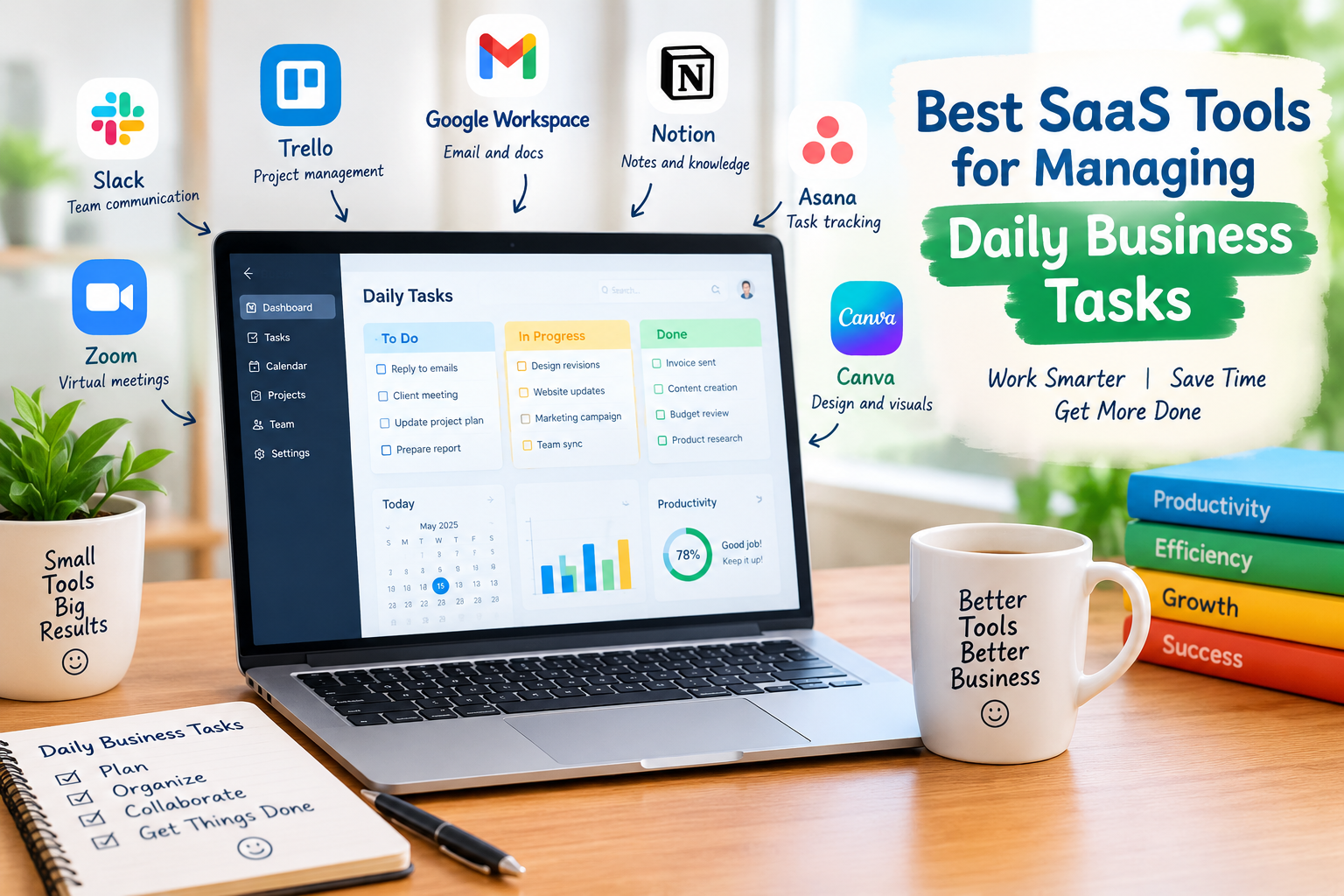
The best SaaS tools for managing daily business tasks can help businesses improve organization, communication, productivity, and time management. Applications such as Asana, Trello, Google Workspace, Notion, Slack, HubSpot, QuickBooks, Canva, and Zoom support different areas of everyday operations.
From my point of view, the most effective approach is to start with a few essential tools that solve real business problems. A small business does not need a complicated software system to become organized. Even a simple combination of task management, communication, and document management applications can make daily work more manageable.
As businesses grow, their software requirements may change. Reviewing tools regularly and choosing applications that match current needs can help maintain an efficient working environment.
Ultimately, SaaS tools are valuable because they allow business owners and employees to spend less time organizing repetitive activities and more time focusing on customers, business development, and long term goals.